

The short answer
AI agent development cost depends mostly on scope. The price turns on the systems it connects to and how much it may do alone. It also turns on the steps a person approves, the content it reads and where it runs. Running costs after launch matter as much as the build, so budget for both.
Search for the cost of an AI agent and you will find prices from $5,000 to over $500,000. Both ends are real. The spread comes from what the agent has to do, not from the AI itself.
This guide shows what published 2026 cost guides say and what drives the number up or down. It also covers what an agent costs to run once it is live. It ends with a checklist for comparing quotes fairly.
What an AI agent costs to build
The cost of an AI agent depends on five things you control. They are its tools, how much it may do unasked, the steps a person approves, the content it reads and where it runs. Published 2026 guides put a focused agent in the tens of thousands of US dollars and a team of agents well into six figures.
The table shows four guides that rank for this question. Each is written by a development firm about its own market, so treat the figures as that firm's view. We checked every page on 15 November 2026. The tiers do not line up exactly, so we placed each range in the closest column.
| Source | Simple agent | Task or workflow agent | Multi-agent or enterprise system |
|---|---|---|---|
| Azilen, updated 15 October 2026 | $10,000 to $50,000 | $50,000 to $120,000+ (task); $80,000 to $180,000+ (knowledge) | $150,000 to $400,000+ |
| Cleveroad, updated 21 September 2026 | $20,000 to $35,000+ | $40,000 to $70,000+ (contextual); $80,000 to $120,000 (autonomous) | $100,000 to $200,000+ |
| ITRex, updated 21 October 2026 | $5,000 to $25,000 | $25,000 to $80,000 | $100,000 to $500,000+ |
| Sparkout, 8 October 2026 | $5,000 to $20,000 | $25,000 to $150,000 | $80,000 to $300,000+ |
Sources: Azilen, Cleveroad, ITRex and Sparkout. ITRex says its figures are what US-based AI developers usually charge.
Two patterns hold across all four. A simple agent that answers from a fixed script stays at the low end. Cost climbs once an agent reads your documents, acts in your systems and works through a task without help.
We do not publish a price list for our own work, because two agents with the same name can differ tenfold in scope. It depends on scope. We give you a clear estimate after a short discovery call.
The five drivers of agent cost
Every quote, ours included, comes down to these five things. You control each of them, which means you can also cut cost by narrowing them.
- Tools and systems to connect. Each system the agent reads from or writes to needs its own link, tests and error handling. Azilen puts tool and API work at $10,000 to $40,000. Sparkout says 40% to 60% of enterprise agent budgets go on integrations and compliance, not the AI model.
- Autonomy. An agent that drafts for a person to send is cheaper than one that acts alone. More freedom means more testing, more limits and more ways to recover from a wrong step.
- Approval steps. Deciding which actions wait for a person takes design work, and so does the screen where people approve them. Sparkout's calculator adds 15% to 20% for human review. It is money well spent on any high-impact action.
- Data and documents. An agent that answers from your policies, contracts or manuals needs that content cleaned, kept current and searchable. Azilen puts this knowledge layer at $15,000 to $50,000.
- Where it runs. A hosted model API is quickest to start. Running on your own servers, or across several regions, adds setup and hardware but keeps data inside your walls.
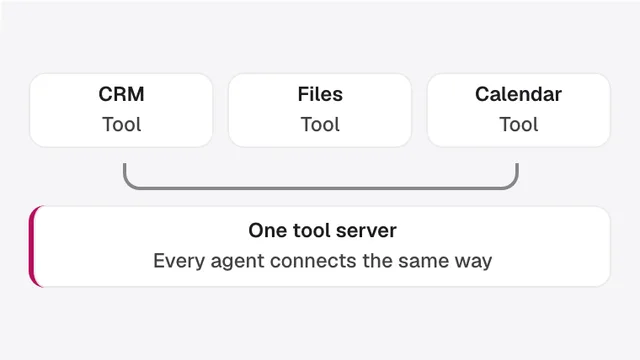
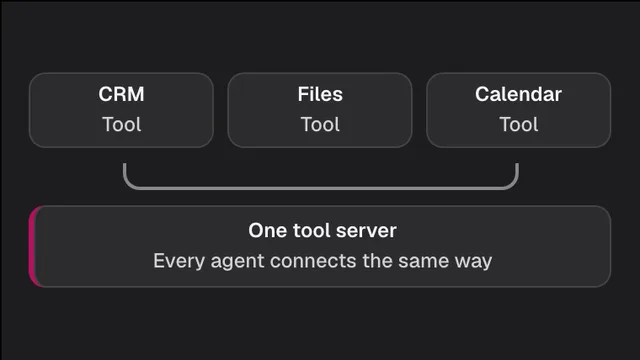
Standards help with the first driver. The Model Context Protocol is an open protocol for linking AI applications to outside data and tools. If a system already has an MCP server, the agent can use it without a custom build.
How long it takes
Time follows scope, just as cost does. Sparkout's guide, for one, gives these figures. A proof of concept takes 4 to 6 weeks and an MVP agent 6 to 10 weeks. A business process agent takes 3 to 6 months, and an enterprise system 6 to 9 months.
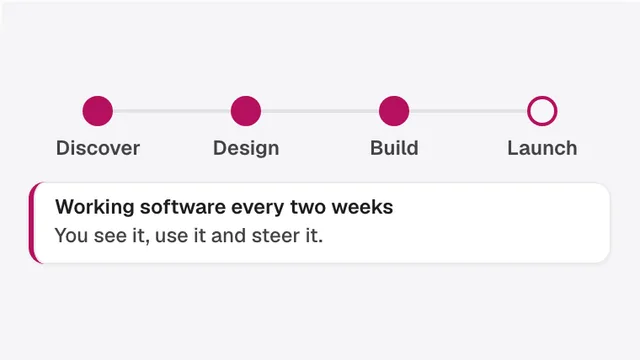
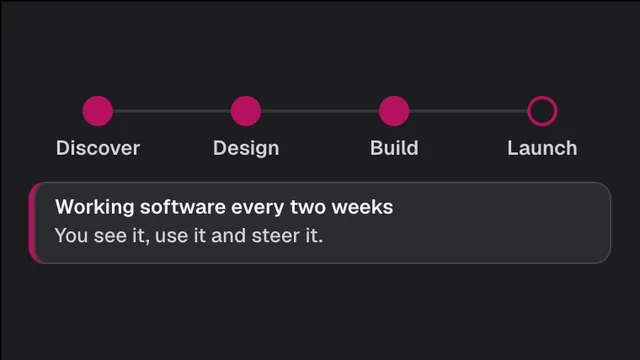
For our own projects, it depends on scope. We give you a clear estimate after a short discovery call. On client projects you see working software every two weeks, so you can judge progress on something real.
Cost per agent when you run several
The first agent carries most of the setup cost. It pays for the links to your systems, the approval screens, the logging and the hosting. A second agent can reuse much of that, so it usually costs less than the first.
A team of agents that work on one task together is a different matter. They need a plan for who does what, checks between steps and tests of the whole chain. Sparkout adds $20,000 to $60,000 for a multi-agent setup. Azilen starts multi-agent systems at $150,000. Ask any partner to price shared parts once and each new agent on its own line.
What it costs to run after launch
Building an AI agent is only part of the cost. Once it is live you pay for model usage, hosting, monitoring and steady improvement. Ask every partner for the build cost and the monthly running cost for the same scope. Ask too which high-impact actions will wait for a person to approve them.
| Cost line | Monthly cost (US dollars) |
|---|---|
| Model usage through an API | $1,000 to $5,000 |
| Search and document hosting | $500 to $2,500 |
| Monitoring and logs | $200 to $1,000 |
| Prompt tuning and updates | $1,000 to $2,500 |
| Access and security upkeep | $500 to $2,000 |
| Total | $3,200 to $13,000 |
Model usage is billed by the token, a small chunk of text. Prices vary widely by model. Anthropic's published price list, checked on 15 November 2026, runs from $0.10 to $8 per million input tokens across its current models. Output costs five times the input rate. Jobs that can wait go through its batch service at half price.
Agents use more tokens than chatbots, because they plan, call tools and check their work. Anthropic's guide to building effective agents notes that agentic systems often trade speed and cost for better results. A good build sends simple steps to a small, cheap model and keeps the large one for hard steps.
Running on your own servers swaps token bills for hardware and upkeep. That suits steady, high-volume work and data that must not leave your building.
Who you need and what they cost
A production agent needs more than one AI developer. A typical team covers these roles, though one person may hold two of them.
- AI engineer. Designs the agent, its prompts, tools and tests.
- Backend engineer. Builds the links to your systems and the approval flow.
- Product or project lead. Turns the workflow into a clear scope and keeps it there.
- QA and security. Tests odd cases and checks what the agent can reach.
Pay depends heavily on country. The US Bureau of Labor Statistics puts the median annual wage for software developers at $135,980 in May 2025. Cleveroad prices a small MVP team at $20,000 to $35,000 or more a month. A full production team, in its estimate, runs $70,000 to $120,000 or more a month.
An Indian team gives you senior engineering at India cost levels, well below US and Western European rates. If you want engineers inside your own team, see how to hire AI developers through us.
How to compare agent quotes
Quotes are hard to compare when each firm prices a different agent. Send every firm the same written scope, then check each quote against this list.
- Does it name every system the agent will read from and write to?
- Does it say which actions the agent takes alone and which wait for a person?
- Does it give a monthly running cost for your expected volume, not only the build?
- Does it include testing on your own past cases, with a pass mark agreed in advance?
- Does it say who owns the code, the prompts and the logs?
- Does it cover monitoring, an off switch and a full record of every action?
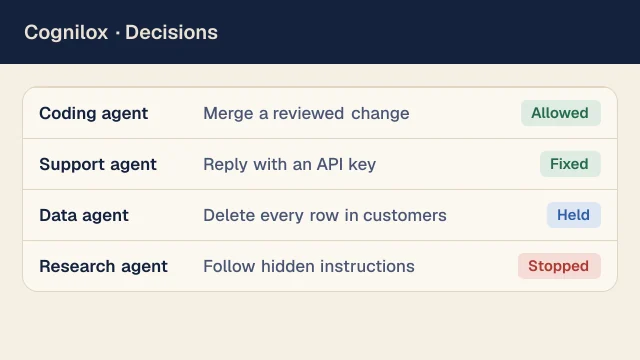
A quote that skips the last point is cheaper for a reason. Gartner predicts that over 40% of agentic AI projects will be cancelled by the end of 2027. Its June 2025 press release blames rising costs, unclear business value and weak risk controls. Tools such as Cognilox help with control. Cognilox checks every AI agent action before it runs.
For the wider picture, read what AI development costs overall and our guide to agentic AI for the enterprise.
An agent we built: Project Sasha
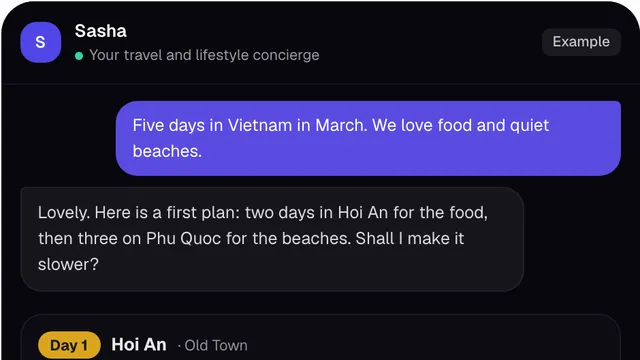
For Kanoe, a company in Spain, we built Project Sasha, an AI travel and lifestyle concierge. People talk or type to Sasha in any language, on the web or on WhatsApp. It plans whole trips across 350,000 places in Vietnam.
Sasha shows where agent cost really goes. Language support and a chat window are the easy part. The work is in the content it plans from and in keeping a large set of places accurate. It is also in the rules for what it may suggest. Those are the same drivers listed above, and the same ones we price for every client.
If you are weighing an agent of your own, our AI agent development company page explains how we scope one. For customer-facing work, see our AI chatbot development service.
Sources
- Azilen, AI Agent Development Cost in 2026: The Complete Breakdown (updated 15 October 2026)
- Cleveroad, What Is AI Agent Development Cost in 2026 (updated 21 September 2026)
- ITRex, How much does AI agent development cost (updated 21 October 2026)
- Sparkout Tech, AI Agent Development Cost in 2026 (8 October 2026)
- Anthropic, Claude API pricing
- Anthropic, Building effective agents
- Model Context Protocol, Specification
- US Bureau of Labor Statistics, Occupational Outlook Handbook: Software Developers
- Gartner, Gartner Predicts Over 40% of Agentic AI Projects Will Be Canceled by End of 2027 (25 June 2025)
Questions
How much does it cost to build an AI agent?
Published 2026 guides range from about $5,000 for a simple rule-based bot to over $500,000 for an enterprise system that works across many tools. The four guides we checked put their middle tier, task and workflow agents, between $25,000 and $180,000. Where your agent lands depends on its tools, autonomy, approval steps, content and where it runs.
How much does a personal AI agent cost?
Personal AI assistants are consumer products. They are usually sold as a monthly subscription, and many have a free tier. A business agent is a different thing. It is built to work inside your own systems, follow your rules and keep a record of what it does. So it has a build cost and a monthly running cost.
Is an AI agent free?
Some tools for building agents are free, and so are some open models. Building and running a business agent is not. You pay for design, links to your systems, testing and model usage or hardware. Azilen puts monthly running costs at $3,200 to $13,000 once an agent is live, checked on 15 November 2026.
What costs the most in an AI agent project?
Usually it is connecting the agent to your systems and making it safe, not the AI model. Sparkout's 2026 guide says 40% to 60% of enterprise agent budgets go on integrations and compliance. Testing on real cases and building approval steps for high-impact actions also take real time.
Can I cut the cost of an AI agent?
Yes. Start with one workflow that has a clear finish line and few systems. Let the agent draft before you let it act. Use a small model for simple steps and a large one only for hard steps. Reuse connections across agents, and use systems that already offer a Model Context Protocol server.
How much does Aptibit charge to build an AI agent?
It depends on scope. We give you a clear estimate after a short discovery call. We price the build and the monthly running cost for the same scope, side by side. On client projects you see working software every two weeks. Write to info@aptibit.com or call +91 91637 44711. We reply within 24 hours.